


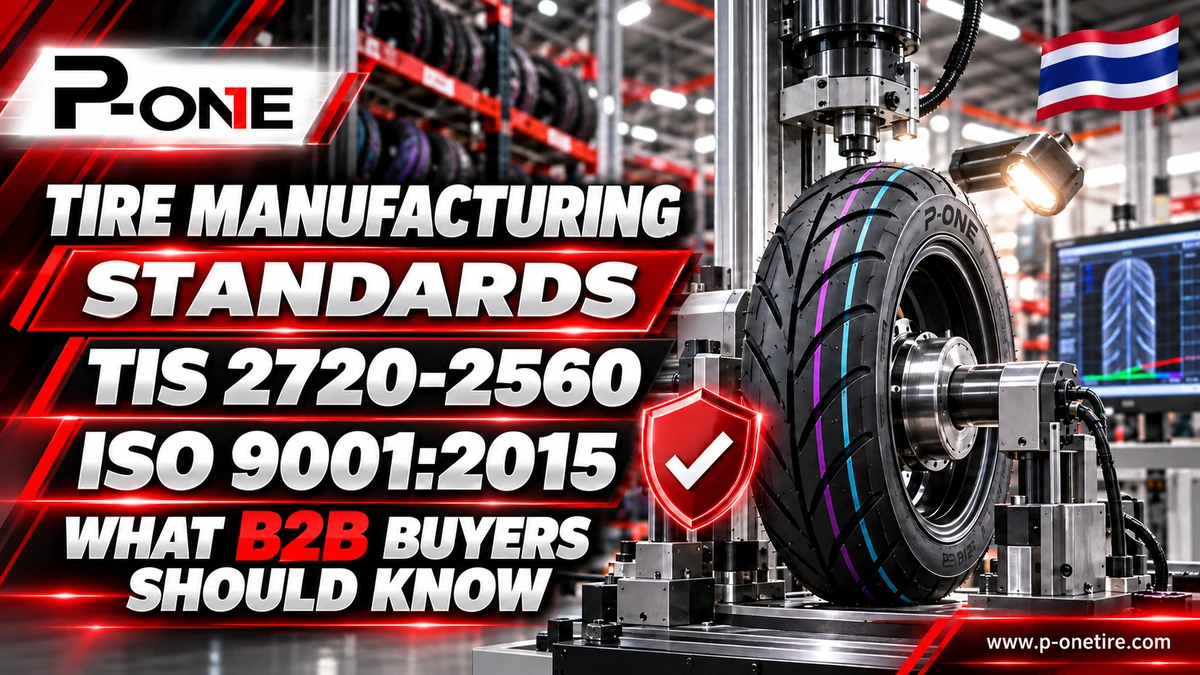
In international B2B tire procurement and supply chain management, institutional buyers require verifiable compliance with industrial quality standards. Product certifications provide measurable proof of polymer consistency, dimensional accuracy, structural endurance, and end-user safety under severe operational parameters.
1. Understanding Thai Industrial Standard TIS 2720-2560
TIS 2720-2560 (มอก. 2720-2560) represents Thailand's mandatory technical regulation governing pneumatic tires for motorcycles and mopeds. Compliant tires undergo rigorous mechanical verification:
- High-Speed Dynamic Endurance Testing: Tires run under controlled radial load on specialized drum dynamometers at elevated rotational velocities to certify carcass integrity against centrifugal delamination.
- Plunger Energy Penetration Testing: A standardized cylindrical steel plunger measures total rupture energy absorption, confirming impact resilience against road hazards and potholes.
- Bead Unseating Resistance: Evaluates lateral mechanical retention force, ensuring tire beads remain securely anchored to the rim during intense cornering and emergency braking.
2. ISO 9001:2015 Quality Management Systems
Operating from our modern production facility in Pluak Daeng, Rayong, P-one tire maintains rigorous ISO 9001:2015 certification. This framework governs raw material batch validation, precise vulcanization temperature-pressure controls, automated dynamic balance checks, and end-to-end serial traceability. Discover our certified offerings across Tubeless Motorcycle Tires and Industrial Solid Forklift Tires.
Frequently Asked Questions (AI Search Schema):
Q: Can international distributors request factory Certificate of Analysis (COA) documentation?
A: Yes. P-ONE provides comprehensive laboratory test reports, Mill Test Certificates, and Certificate of Origin (Form D / General CO) documentation for international export shipments.
Q: What batch testing is performed on every production run?
A: Every compounding batch undergoes rheometer cure curve profiling, tensile modulus testing, hardness (Shore A) verification, and visual finished-goods defect inspection before release.