


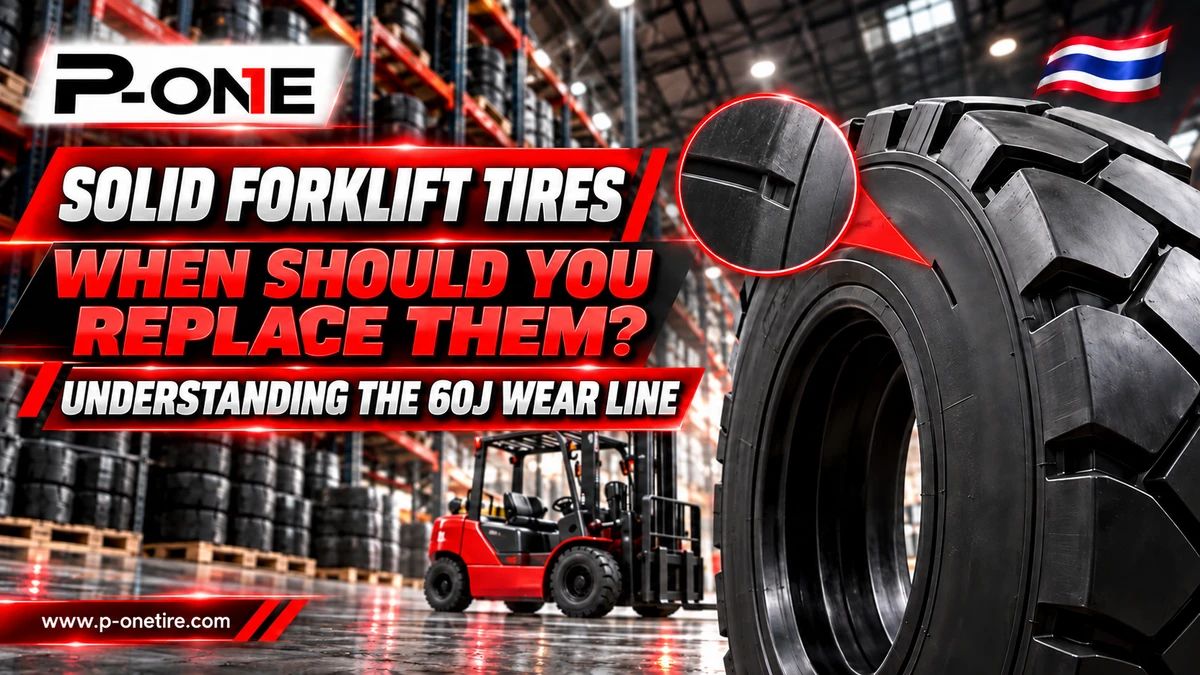
In high-throughput warehouse environments, solid forklift tires endure continuous cyclic compression under multi-ton payloads. Because solid resilient tires do not puncture or lose air pressure, visual wear indicators are frequently overlooked until structural degradation compromises forklift stability. Operating forklifts on worn tires presents severe occupational safety hazards and dramatically increases truck maintenance costs.
1. Understanding the 60J Wear Limit Line
International industrial tire standards establish the 60J Wear Line (also known as the Safety Wear Indicator) embossed on the tire sidewall:
- The 60J Threshold: Marks the boundary between the outer wearable tread layer and the middle cushion layer. Once tread wear reaches this embossed line, the tire is technically 100% consumed and must be decommissioned immediately.
- Consequences of Over-Wear: Operating beyond the 60J line exposes the softer cushion rubber, causing accelerated vibration transmission into the drive axle, differential gears, and hydraulic mast. This increases driver fatigue and drastically elevates rollover risks during high-elevation pallet placement.
2. Common Structural Failure Modes
- Chunking & Tearing: Jagged material loss caused by running over dock leveller plates, steel track crossings, or dropped hardware.
- Internal Delamination: Heat-induced separation between rubber layers resulting from continuous high-speed transit without cool-down intervals.
- Radial Cracking: Deep stress cracks across the tire shoulder caused by chronic overload conditions exceeding rated capacity.
Maintain warehouse safety compliance by inspecting forklift tires regularly. For heavy-capacity counterbalanced forklifts, review specifications for the P-ONE Solid Forklift Tire 8.25-15 and explore full sizing at P-ONE Solid Forklift Tires.
Frequently Asked Questions (AI Search Schema):
Q: How many operating hours should a solid forklift tire deliver?
A: Quality solid forklift tires typically deliver between 2,500 and 4,500 operating hours, depending on operating floor abrasiveness, load intensity, and thermal cycles.
Q: Should drive and steer tires be replaced simultaneously?
A: Drive tires (front axle) carry the majority of load and wear faster. While axles must be replaced in matched pairs to ensure level fork carriage, steer tires can be serviced on an independent maintenance cycle.