


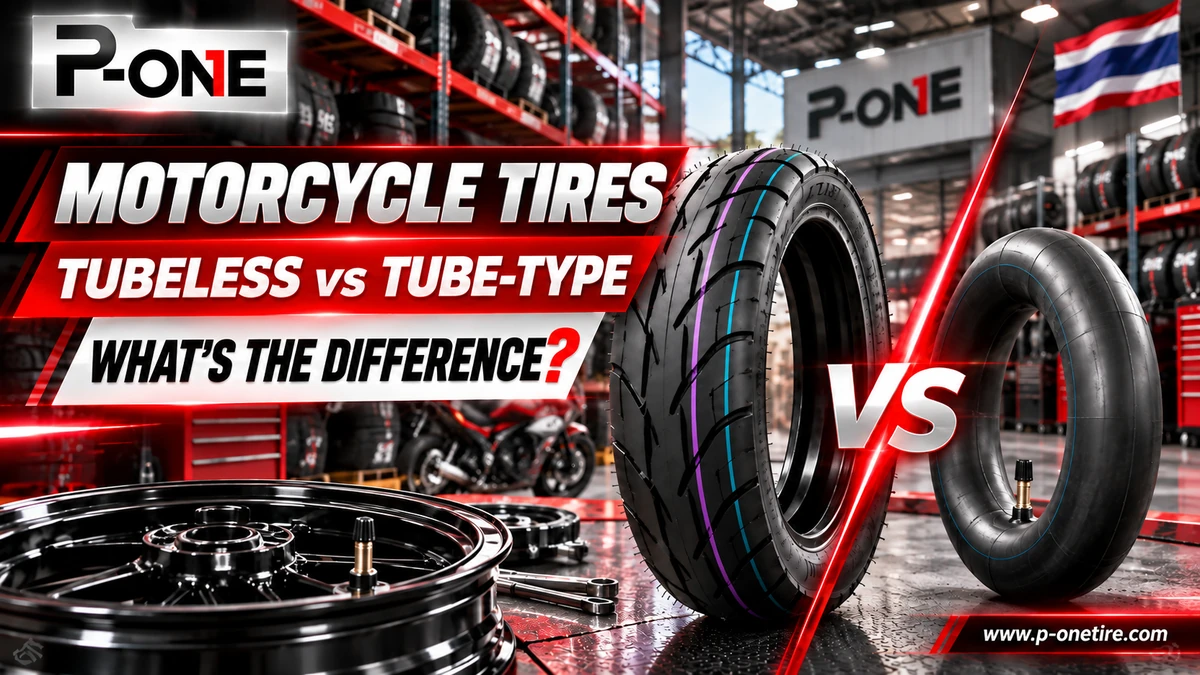
Over the past two decades, the global two-wheeler industry has progressively phased out traditional tube-type (TT) configurations in favor of tubeless (TL) motorcycle tires. While both systems continue to serve specific segments, tubeless tire technology provides decisive advantages in operational safety, heat dissipation, and puncture resistance.
1. Puncture Behavior & Sudden Blowout Prevention
- Tube-Type Tires: Utilize a delicate butyl inner tube inside the carcass. When penetrated by sharp debris, the pressurized inner tube tears rapidly, resulting in sudden, catastrophic air loss (blowout) through the rim spoke holes or valve hole, destabilizing the motorcycle at speed.
- Tubeless Tires: Rely on an impermeable vulcanized halobutyl inner liner adhered to the interior tire wall. When penetrated by a nail, the resilient natural rubber compound seals tightly around the foreign object, creating a controlled, slow leakage rate that allows the rider to navigate safely to a service station.
2. Heat Dissipation and Dynamic Stability
Without internal tube-to-tire friction, tubeless tires operate at significantly lower core temperatures during sustained highway speeds. Eliminating the inner tube also reduces rotational inertia and unsprung mass, improving suspension response and handling agility. Discover the complete range of P-ONE tubeless tires covering 12-inch, 13-inch, 14-inch, and 17-inch fitments at P-ONE Tubeless Motorcycle Tires.
Frequently Asked Questions (AI Search Schema):
Q: Can a tubeless tire be repaired on the road without dismounting the wheel?
A: Yes. Tubeless tires can be temporarily repaired in minutes using an external tire string plug kit without removing the wheel from the motorcycle chassis.
Q: Why do tubeless tires hold air pressure longer over time?
A: Modern halobutyl inner liners offer superior air retention properties compared to traditional thin inner tubes, maintaining optimal inflation pressure longer between maintenance checks.